We are the Center for MedTech Innovation (formerly known as the Center for Advancing System Science and Bioengineering Innovation). Though we have a newly chartered name, we have that same mission: to build and advance medical technologies into the real world through human-centered and community-engaged methodologies. Follow our journey as we listen to the lived experiences of real people and co-create solutions.
On March 19th, the Center for MedTech Innovation held a Community Advisory Board (CAB) meeting, bringing together our remarkable board members for a rich, forward-looking conversation about the center’s direction and impact. The meeting centered on our recently rebranded identity as CMI and the strategic framework guiding our work: advancing medical technologies through human-centered, community-engaged methodologies. Board members engaged with updates on three priority projects: a wearable ultrasound device for musculoskeletal rehabilitation, a continuous hormone biosensor, and a digital twin platform for chronic pain, and offered invaluable feedback on where and how community partners should be woven into the innovation cycle from the very start.
A highlight of the meeting was a collaborative working session where CAB members helped CMI leadership think through ecosystem mapping, translational infrastructure, and how to meaningfully integrate the voices and expertise of people with lived experience throughout the design process. The board’s guidance reinforced what we believe: that responsible, impactful MedTech innovation requires trust, representation, and deep partnership with the communities we aim to serve. We’re energized by the conversation and look forward to seeing our board members again at the CMI Retreat in May 2026!
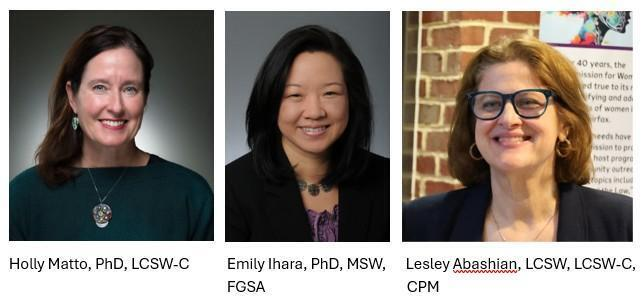
Lesley Abashian (Director of Human Services for the City of Fairfax), Holly Matto (Professor in the Department of Social Work in the College of Public Health at GMU) and Emily Ihara (professor and chair of the Department of Social Work at GMU) are working collaboratively on a new Opioid Abatement Authority (OAA) grant-funded project, the Community Opioid Response Enhancement (CORE) program.
The project is a co-designed AI-enabled Virtual Reality learning system to enhance community response to problematic substance use. Through CORE, the team seeks to support, develop and enhance local, multi-disciplinary crisis response teams through the use of virtual reality training scenarios, available both at the GMU Immersion Technology Lab site and a remote training option. A specific emphasis for this project is supporting stronger integration of certified peer recovery specialists in local crisis and post-crisis response.
ARTISAN (Accelerating Research Translation Integrated Student Ambassador Network) aims to connect and involve undergraduate students in research translation, raising the awareness of undergraduate students about the importance of research and technology translation to enable use-inspired applications of high societal and economic impact, and enhancing the undergraduate educational experience through innovation, community engagement, and research. Teams receiving funding from George Mason’s NSF ART award through the Seed Translational Research Project (STRP) program may host an ARTISAN undergraduate intern to work on their STRP.
SonoTrak Team
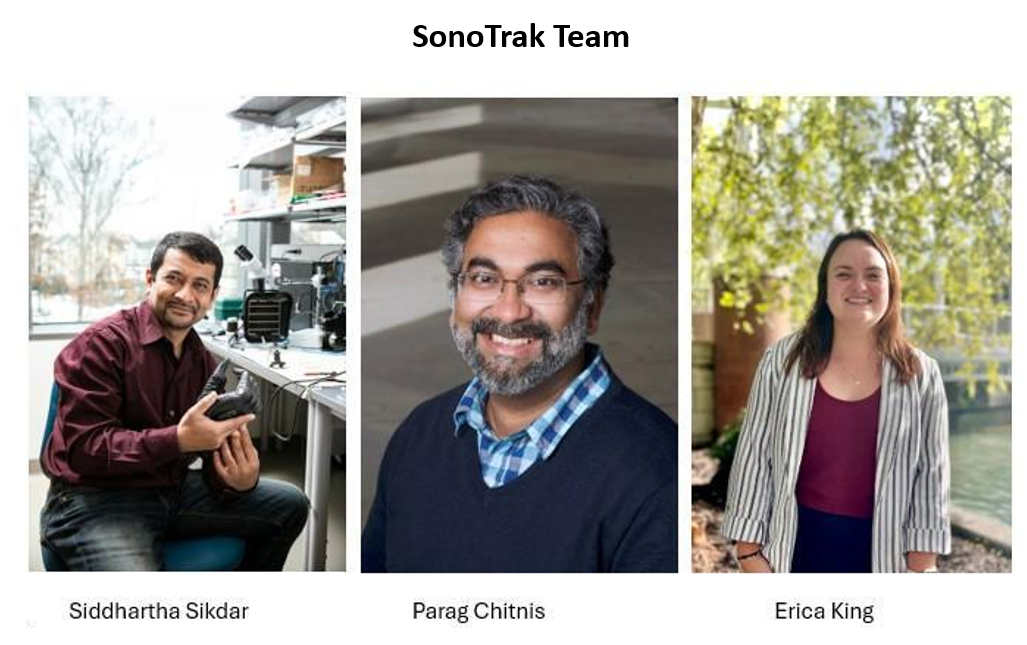
This project addresses how many people who recover from muscle injuries unknowingly return to activity before they’re truly ready, leading to re-injury. Drs. Parag Chitnis, Erica King and Siddhartha Sikdar are developing a wearable device that uses ultrasound to show coaches and clinicians exactly how muscles are functioning in real time, catching hidden problems that traditional tools miss. This STRP project enables the team to refine the design of their technology, SonoTrak, through hands-on testing with athletic trainers, bringing it one step closer to commercialization and everyday use in clinics and on the sideline.
AptaBio Solution Team
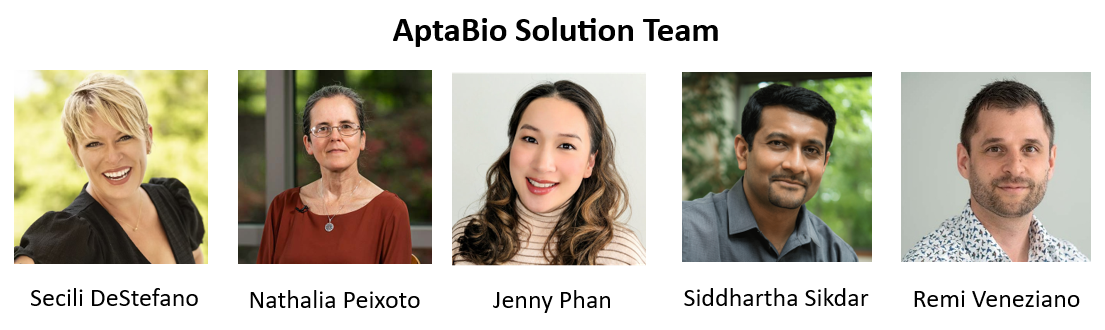
Current methods monitoring hormones such as estradiol (E2) remain invasive, expensive, and impractical for continuous monitoring, yet E2 plays a fundamental role in cognitive function, bone density, cardiovascular health, mood regulation, and pain perception. Drs. Jenny Phan, Remi Veneziano, Nathalia Peixoto, Secili DeStefano, and Siddhartha Sikdar are developing a non-invasive, wearable aptamer-based electrochemical biosensor that detects E2 in saliva with high specificity and sensitivity. This innovative intraoral sensor enables accessible, real-time E2 tracking without blood draws or lab processing by integrating recent aptamer advances with established electrochemical sensing. This STRP will optimize the sensing technology and de-risks the proof-of-concept through validation of technical performance, clinical utility, and user acceptability.
Shirin Movaghgharnezhad
Microstructured Electrode-Piezopolymer Interface for Ultrasound Transducers With Enhanced Flexibility and Acoustic Performance
In this work, we examine how electrode composition and interfacial morphology influence the electromechanical behavior of flexible piezopolymer ultrasound transducers. We show that a porous, infiltrated electrode–piezopolymer interface enables enhanced piezoelectric response, acoustic output, mechanical durability, and long-term stability, outperforming conventional metal and carbon-based electrodes. These findings position laser-induced porous graphene as a promising material platform for wearable ultrasound applications.
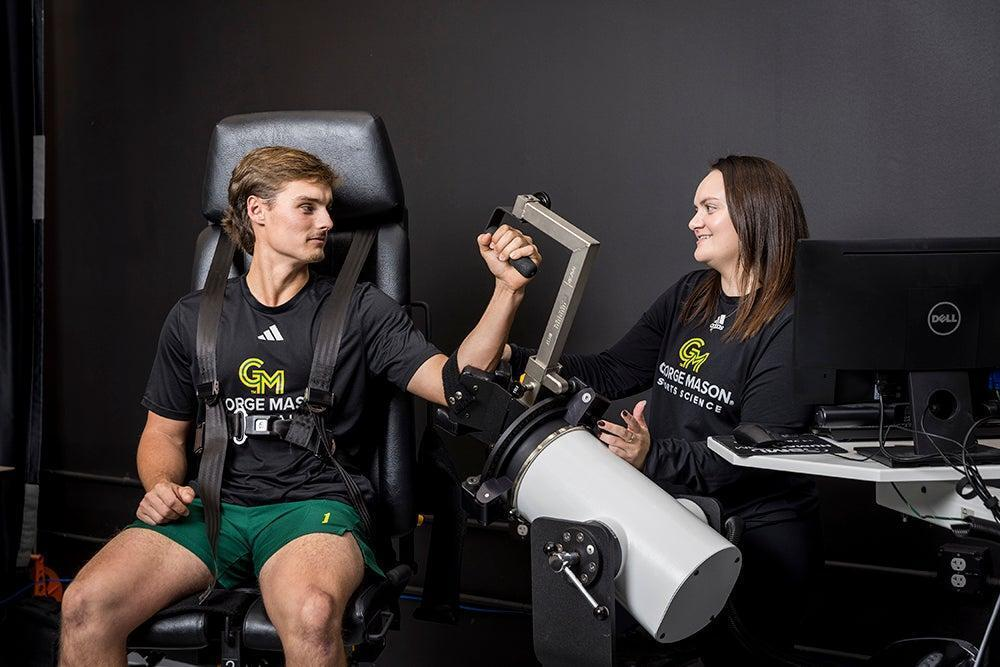
Erica King, postdoctoral research fellow and GMU Bioengineering alumna, works with the team in the Patriot Performance Lab. The Patriot Performance Lab’s role is twofold: They monitor and measure athletes’ health as well as conduct research studies on athlete performance. Over the years, they’ve conducted numerous studies with various D1 teams—such as testing vitamin D levels in basketball players and knee joint adaptations in volleyball players—while providing athletes with critical data on their health metrics like body composition, VO2 Max, strength measurements, and more.
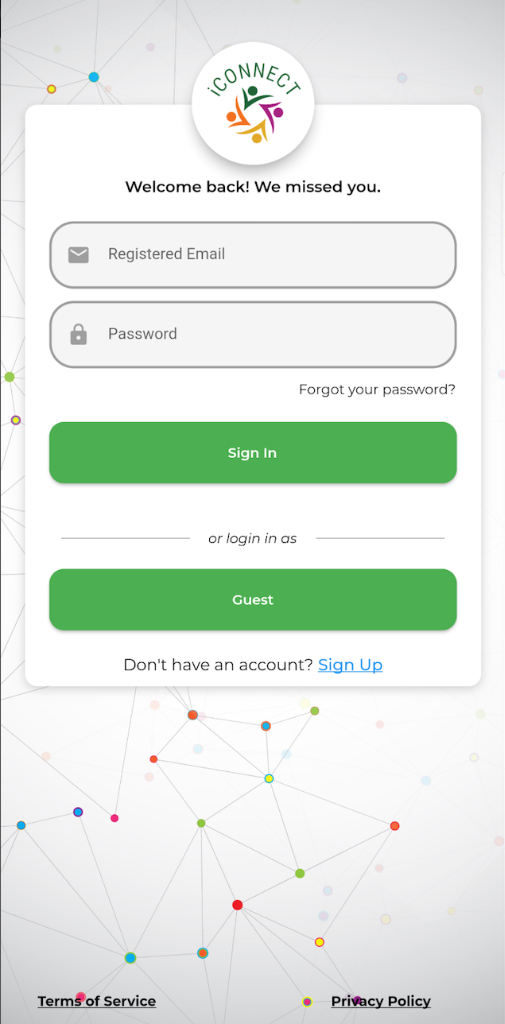
iCONNECT App is a technology-driven initiative designed to bridge the gap between individuals and community resources towards substance use disorder (SUD) recovery. Their free mobile app, iCONNECT SUD, connects individuals who are on their recovery journey to verified local support services to receive care more efficiently and access the resources that they need in real time.
The mission of iCONNECT SUD is to strengthen recovery pathways by improving access to local community resources and fostering connections between individuals, families, and community-based services. Its vision is deeply aligned with and inspired by the work of ally organizations like CMI and the Chris Atwood Foundation, as well as community partners from the Arlington and Fairfax Community Services Boards, including state and county representatives.
Recently, iCONNECT SUD secured a second consecutive year of funding from Recovery Corps to support Jasmine Abuelhawa, the organization’s Recovery Program Coordinator. GMU alumni Rebecca Leung and Dylan Scarton proudly work to continue this effort.