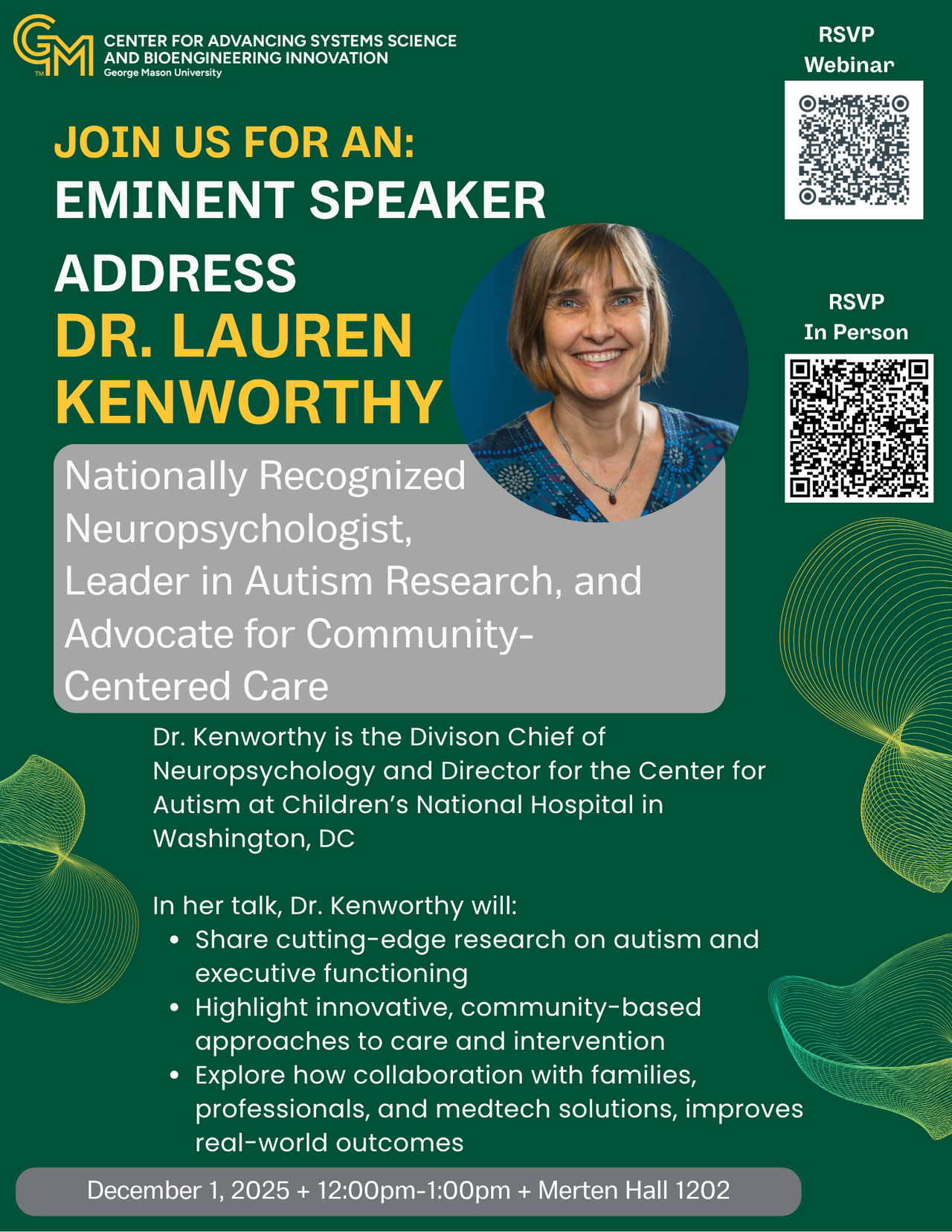
Date: December 1, 2025
Time: 12:00 PM – 1:00 PM
Location: Merten Hall 1202
Speaker: Dr. Lauren Kenworthy — Nationally Recognized Neuropsychologist, Leader in Autism Research, and Advocate for Community-Centered Care
Dr. Kenworthy is the Division Chief of Neuropsychology and Director for the Center for Autism at Children’s National Hospital in Washington, DC.
In her talk, Dr. Kenworthy will:
- Share cutting-edge research on autism and executive functioning
- Highlight innovative, community-based approaches to care and intervention
- Explore how collaboration with families, professionals, and medtech solutions improves real-world outcomes
CASSBI is hosting a one-day Design Sprint & Holiday Feast to surface priorities for 2026, build cross-disciplinary teams, and celebrate our community’s work.
The CASSBI Design Sprint & Holiday Feast is a one-day collaborative event bringing together past trainees and community partners to co-design the future of CASSBI at George Mason University.
Participants will leave having contributed to shaping research priorities, forging new collaborations, and inspiring practical strategies to advance systems science and bioengineering innovation.
When: 9:00 AM–3:00 PM on Monday, December 15
Where: GMU Fairfax Campus; Johnson Center Room B
Who: Past trainees and community partners working in IDD, bioengineering, psychology, CS, social work, and allied fields
What to expect:
- Lightning highlights from CASSBI NRT projects
- Round 1: map challenges and opportunities
- Holiday feast lunch
- Round 2: solution sketches + mini roadmaps
- Report-outs, voting, and a celebratory close
The Center for Advancing Systems Science and Bioengineering Innovation (CASSBI) convened its second Advisory Board meeting on October 27, 2025, at George Mason University’s Fairfax Campus. Board members and center leadership discussed the center’s strategic realignment toward innovation, university-wide integration, and new revenue-generating models to sustain translational research and community partnerships.
Key discussions centered on establishing a Center for MedTech Innovation identity, bridging academic research with real-world application through structured pathways for feasibility, proof-of-concept, and proof-of-value development. The Board emphasized the importance of focusing on investable, mission-aligned projects—particularly two emerging initiatives: a wearable ultrasound for musculoskeletal rehabilitation and a real-time estradiol biosensor for women’s health.
Members also provided valuable input on defining commercialization handoff processes, aligning intellectual property and equity frameworks with university policies, and developing cost centers to support early-stage prototyping. The Board encouraged continued emphasis on patient-centered design, disability inclusion, and paid consultation models that elevate lived experience expertise within innovation pipelines.
Next steps include finalizing the center’s naming and branding strategy, formalizing its cost-center and equity models, piloting consultation and fellowship programs, and securing internal and external funding for proof-of-concept work.

How Shared Values Can Guide Best Practices for Research Integrity, Social Justice, and Principled Education
Dr. Jenny Phan, CASSBI’s Assistant Director of Community Engagement, and members of the FORRT Neurodiversity Team (Sara L. Middleton, Flavio Azevedo, Bethan J. Iley, Magdalena Grose-Hodge, Samantha L. Tyler, Steven K. Kapp, Siu Kit Yeung, John J. Shaw, Helena Hartmann).
Not all people conform to socially constructed norms, nor should they have to. Neurodiversity, the natural variation in human brains and cognition, is fundamental to understanding human behavior, yet neurodivergent individuals in academia are often stigmatized, undervalued, or pressured to mask their differences. This position statement, authored predominantly by neurodivergent scholars, explores how aligning the values of the neurodiversity movement with practices of Open Scholarship (OSch) can foster greater research integrity, rigor, social responsibility and justice, diversity, equity, inclusivity, and accessibility in academia.
We review systemic barriers faced by neurodivergent researchers—from disclosure dilemmas and hidden curriculum expectations to intersectional disadvantages—and identify how OSch principles (transparency, accessibility, collaboration) can help mitigate these challenges. Drawing on lived experiences and current research, we propose concrete reforms, including adopting universal design in scholarly communication, promoting participatory research methods, and enacting supportive policies (e.g., flexible work arrangements, inclusive codes of conduct). By leveraging shared values of openness and neuro-inclusion, academia can become more just and epistemically equitable.

This systematic review identifies key kinematic markers for real-time fatigue assessment during walking, highlighting how fatigue alters gait stability through changes in step width, stride time, and trunk acceleration variability. The findings emphasize the need to tailor fatigue monitoring methods to specific activities and provide a foundation for real-world fatigue detection using wearable technologies.
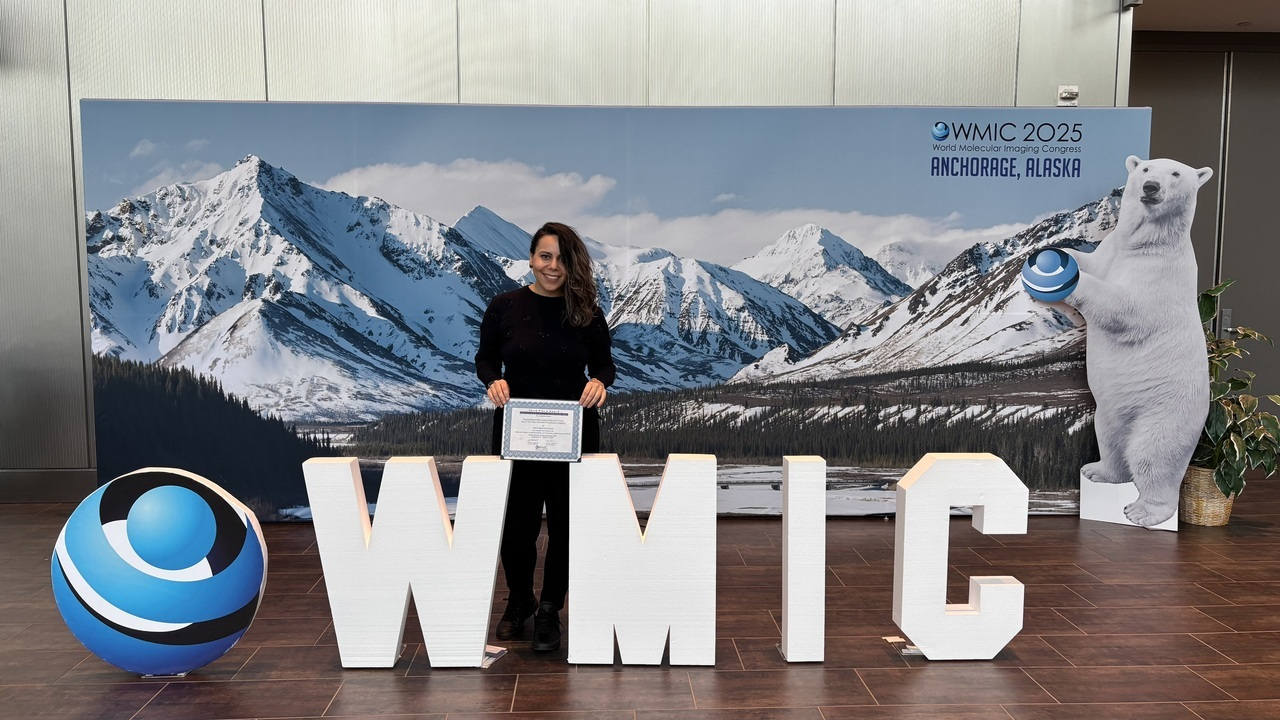
Nasrin Hanafi, a Ph.D. candidate in Bioengineering at George Mason University, is developing innovative DNA-based nanosensors for deep-tissue optical imaging of brain activity and cancer. Her research was recently recognized at the 2025 World Molecular Imaging Congress (WMIC) in Anchorage, Alaska, where she received two prestigious honors: the WMIC Poster Award in New Chemistry, Materials and Probes, and third place in the MINT (Molecular Imaging in Nanotechnology and Theranostics) Young Investigator Award competition.

Bioengineering PhD candidate Bryce Dunn recently presented his research at the World Molecular Imaging Congress in Anchorage, Alaska, and the Biomedical Engineering Society meeting in San Diego, California. His work focuses on how shortwave infrared fluorescence imaging can be used to detect and monitor electrophysiological activity, offering new ways to visualize what’s happening in the nervous system. Bryce also made significant contributions to an award-winning poster and presentation led by Nas Hanafi.